Thursday, 28 August 2014

An historical view on Scottish independence

Robert the Bruce
Whether we like it or not history shows us that Scotland and England have very close ties and their economies have been intertwined for over 1000 years. Even before the Norman conquest Anglo-Saxons arrived in some parts of Scotland and so we can see that ‘Alba’ was made up of Gaels, Scots, Picts Vikings, Britons, Angles and latterly Anglo-Saxons. After the Norman conquest there was intermarrying between the powerful Scottish and Norman families which added Normans into the mix. So by the time the great Robert the Bruce is crowned King of Scotland it was already a country with roots leading back into many other countries and cultures. Indeed Robert the Bruce was himself of Norman origin.

Looking back we can see as early as 1100 there was integration between the crowns of Scotland and England - Edith known as Matilda, daughter of Malcolm III of Scotland, marries King Henry I of England. There were many twists and turns over the centuries which could have led to a different outcome today. After the death of Alexander III of Scotland, Margaret, Maid of Norway inherited the Crown in 1286. Had she not drowned on her way to Scotland in 1290 the map of Europe might have been very different with Scotland and Norway being united. However that wasn’t the case and the entanglement between the Scottish & English crowns became ever closer. After Margaret died an heir could not be agreed amongst the Scottish lords and so they appealed to Edward I of England. In 1292, Edward I of England grants the Scottish throne to John Balliol, an Scottish/Anglo-Norman. He was followed by another Scottish/Anglo-Norman, Robert I (Robert de Brus), popularly known as Robert the Bruce. So, one can see that the influence of the Normans in the British Isles culminated in Norman ascendancy in the Scottish Crown. This may have led to disputes but inevitably it led to economic and political integration.
Some may see the action of the Scottish lords as being fatal but in practical terms it set the seal on the future destiny and later integration of both crowns of Scotland and England. 

Eventually in 1603 James VI of Scotland inherited the English crown and by his own words he declared the joining of the two crowns as ‘Britain.’ Under James both parliaments continued to sit, one in Scotland and one in England. As we see so expertly revealed in Episode 1 of BBC Scotland series – 'The Stuarts' by Dr Clare Jackson it was the English Parliament who were reluctant to integrate with the Scottish Parliament. 

This integration wasn’t to happen until 1707 when the Scottish Parliament voted for a single parliament under the Crown of Great Britain. Why did they do this? It was claimed that union would enable Scotland to recover from the financial disaster wrought by the ‘Darien’ scheme. (The colonization project that became known as the Darien Scheme was an unsuccessful attempt by the Kingdom of Scotland to become a world trading nation by establishing a colony called "Caledonia" on the Isthmus of Panama on the Gulf of Darién in the late 1690s. Today, the site of the colony is now called Puerto Escocés, or Port Scotland).

From 1707 onwards Scottish MPs sit in the British Parliament.

Of course that is not the end of the matter. Charles Edward Stuart, (Bonnie Prince Charlie), grandson of James II of Britain, is the cause of an uprising after he arrives from the continent where he had been born and lived all his life and where he had been encouraged by the Pope and Catholic forces on the continent to claim the throne of Scotland. This Jacobite uprising fails as we all know. Scotland certainly suffered after this uprising and we can see the physical evidence of military occupation under the Georgian kings around Scotland. 

However much happened in terms of the economic, engineering, artistic and academic development in Scotland in the 18th, 19th & 20th centuries which puts Scotland on the world stage where it remains. So, why is independence necessary? Perhaps some of the leaders of the independence movement want to strut the world stage like kings of old? 

Wednesday, 27 August 2014

Scottish Independence Vote


Personally, I am not one who is enthused by the idea of ‘nationhood,’ – I am more concerned to live in a peaceful, democratic society with a strong economy that can sustain our children and future generations. I am more concerned with the development of our cultural & historical heritage rather than distinct legal national borders. I suppose my feelings on this matter are partly rooted in my ancestry which is a combination of Welsh, German and English. Also, my wife’s father was born in Glasgow. I am happy seeing myself as a European and as Welsh, English and German with Scottish links. Now, I see myself as a ‘man of Sussex’ (where I have lived for over 30 years) as well as a citizen of the world where I wish to travel and understand other peoples and enjoy their culture and history!

I do not believe we should go back to the concept of ‘tribal like’ land disputes of the past dividing up this little planet but to seek co-operation between countries and regions for economic, ecological and future sustainability reasons; to protect ourselves and to have influence over other spheres of the world working towards world peace but at the same time to protect us from aggression, extremism and terrorists. As John F Kennedy said: “United, there is little we cannot do in a host of cooperative ventures. Divided, there is little we can do -- for we dare not meet a powerful challenge at odds and split asunder. As the Greek philosopher, Aesop, tells us: “United we stand, divided we fall”.

We have to think how all the billions of people in our fast growing world population are going to live in peace and be fed; not who runs which little corner of the world.  

We can all regret the passing of nations for example the King of the Britons, the  great King Arthur, that great mythical British Monarch; the loss of the Welsh principality; the loss of the Kingdom of Wessex and the Kingdom of Northumbria and the like ……… but what remains and what we must cherish & nurture is the historical & cultural heritage. I do not believe that formal fixed borders will help us economically or culturally. In fact the more one divides up the geography of our planet the more likelihood there is for dispute and economic difficulties. For example I believe the federation of 52 American states in the form of the USA is far better than 52 separate countries!  As for Europe, before the formation of the EU the people of Europe had suffered from centuries of war and economic crisis.  


The vote in Scotland next month is a simple action, too easily taken but what will follow is a long period of economic uncertainty and to what benefit? The debate seems to have been inward looking and not outwards to the world where our destiny really lies.

Friday, 4 April 2014

EU funding for Sussex

The technology centre at New England House in #‎Brighton is undergoing a major rebuild and expansion as a result of winning funding from the European Regional Development Fund (ERDF), the 161 million Euros programme currently funds nearly 150 co-operation projects between France and England, which involve some 550 different organisations on both sides of the Channel. See these links: 


The EU European cross-border programme 


Saturday, 24 August 2013

Fuel Poverty Advisory Group support fracking

Fuel Poverty Advisory Group support 'fracking'

August 2013: Fuel Poverty Advisory Group chair Derek Lickorish said that ministers had a “duty” to champion the extraction of shale gas because of its potential to reduce the cost of energy. Referring to a protest against energy company Cuadrilla at a site in Balcombe, West Sussex, Mr Lickorish said “the voice of the fuel poor has been lost in the current frenzy”.

See articles in:


The Times

Local Government Chronicle 

See also:

Friday, 1 March 2013

The Eastleigh By-election


It is worrying that UKIP had such a strong performance. We in the UK are mistakenly fixating on blaming Europe for all our problems. Sadly, many in the UK have been negative about Europe for nearly 100 years!, - since WWI. My grandfather, as a stone mason, came to England from Germany, in 1879 and worked on some of the great buildings of London, including, Tower Bridge, The Houses of Parliament & the V&A Museum. His four sons fought in the British Army in WWI, for peace in Europe. My father (who served in the Army in Hong Kong & was captured)  fought for world peace in WWII. Europe is about keeping the peace, building strong economies & democracies in a complicated world. By working together, we in Europe can continue working for peace beyond Bosnia into Mali, Afghanistan, Syria; whilst building strong economies & trade within and beyond the EU. The UK, standing on its own cannot hope to deal with these issues. Shakespeare's image of England …….. “This precious stone set in the silver sea” may have been right for the Royal Court of Queen Elizabeth I but today isolationism would mean that the UK would become an irrelevant island if UKIP had their way.

Tuesday, 15 January 2013

The Runaway Cafe, Lewes - a plea for a reprieve!


Dear Mr Burchell,
Managing Director, Southern Railways,
Go-Ahead House, 26-28 Addiscombe Road, Croydon, Surrey, CR9 5GA


URGENT

I write further to my email of November last year when I asked you to allow the existing tenant at the Runaway Cafe to be retained. Sadly, your recent decision shows you do not intend that to be the case. However, please would you can reconsider this decision? Also, I invite you to come here to Lewes and meet the local residents and users of the cafe.

I understand that a petition was submitted to you during the tender process with some 5000 signatures on it. I'm sure you will agree this is a large number of people supporting the existing cafe. To my knowledge you haven't explained why you ignored this petition. Did you receive complaints over the past three years about the existing tenancy? During this tender round did you receive suggestions that the existing tenant should be replaced? Did you consult The Passenger Watchdog (Passenger Focus)?  I see from the notice you've placed outside the station you say that you've “secured the best deal for Lewes passengers.” Since you didn't take any notice of the petition and as far as I know didn't offer any public consultation to passengers, your officials in Croydon and Newcastle have evidently decided that they know better than the people of Lewes. This smacks of arrogance.

You said in your reply to my email that “It would not be fair to other businesses that are interested in operating the cafe at the station if Southern were to automatically renew the existing lease”. I really don't understand the logic of this, – if there is an existing service which everybody is happy with, why change it? Also, I don't understand the rationale that you apply about being fair to other businesses. Where is the fairness to the existing business? You've now made a lady and her staff redundant with nowhere to go! To be fair is one thing but why did you go around the town asking other cafes in Lewes to tender for the business? That sounds like a positive move to oust the existing tenant!

You also said in your reply that “there will continue to be a place where small businesses and start-up businesses can establish themselves and flourish”. What is your answer to the existing tenant on this point then?  – they have been crushed because of ‘big brother’ at Southern Railways. You've appointed a contractor who already has multiple outlets on stations and other places from Birmingham to Brighton! It seems that in this case you've torn up your ‘small business’ policy.

I look forward to hearing from you. Please note that this is an open letter

Yours sincerely,

Victor S Ient
A resident of Lewes in the area since 1984 and a user of the rail service from Lewes for over 25 years.

Friday, 14 December 2012

Want to know more about 'fracking'?

(updated: March 2016)

In the UK the Government is favour of fracking for gas. Also, protection for National parks has been partially removed:


BBC News: 
MPs have voted to allow fracking for shale gas 1,200m below national parks and other protected sites. The new regulations - which permit drilling from outside the protected areas - were approved by 298 to 261. Opposition parties and campaigners ...

Follow Fracking for Gas for more updates. 

Fracking summary:

With the recent UK government decision on 'fracking' this a 'must read' and very informative article from the National Geographic Dec 2012 about the development and problems caused (& benefits to the US economy)  of this form of gas extraction over the last 10 years in the USA. See the maps, graphs and articles about the problems, technology used and economics. I was surprised to read how much this fuel has already replace coal fired power stations. Follow this link:
http://ngm.nationalgeographic.com/2012/12/methane/lavelle-text


Those who want to know more about ‘fracking’ should read the National Geographic article mentioned above. 

This is a good exposé on the matter. Should one be for or against? I am definitely for economic renewable energy and would like all countries to move away from coal, oil & nuclear. Natural gas or methane gas in the absence of 100% renewable is a good option. 

The issue is how to get hold of methane? Drilling for shale gas has its problems but is it worse than drilling for oil in the sea with all the risks that come with that? I would content that drilling for oil in the arctic could cause massive pollution of the sea. Also do we want more catastrophes like Deep Water Horizon

The jury is still out on hydraulic fracturing or ‘fracking’ but in the UK we have to weigh the benefits of 'home' production against imported gas. The UK is currently importing vast quantities from Mr Putin’s Russia and other sources. Making us 100% self-sufficient in fuel is highly desirable for the UK. Making us self reliant in terms of renewable energy is an even better objective. 

The Daily Telegraph in Sept 2015 reported:

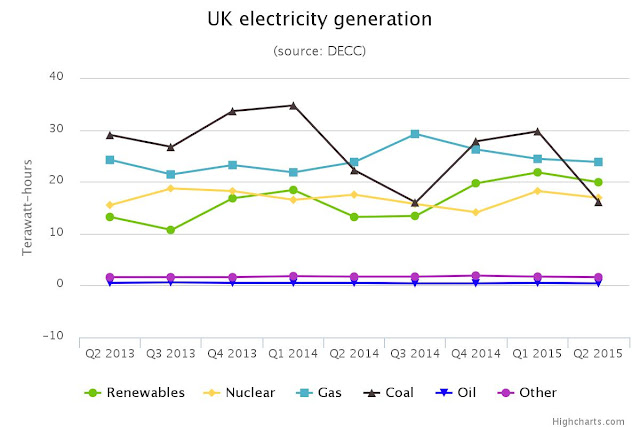
A record high of 25.3 per cent of the UK’s power came from wind, solar, biomass and hydro-electric sources in the three months to June, up from just 16.7% in the same period the year before: Click chart for DT article: 


 Daily Telegraph Renewables


Back to Fracking:  

Those who criticize this form of fuel extraction should firstly study the US situation where hydraulic fracturing has been in operation for at least the last 7 years on a large scale. The UK press will no doubt have a field day on the subject of ‘earthquakes’ which, I believe is a red herring. What we need is informative articles on this form of exploration. We in the UK can’t have our cake & eat it. There is a growing campaign against wind farms and will be against fracking. By what is the alternative? More global warming,  with reliance on coal, oil & nuclear?  

Along with renewables, methane (natural gas) is good for the UK. The vast reserves of methane below the surface cannot be ignore when weighed against our ferocious appetite for energy and against the use of oil, coal & nuclear. 

So why is methane good? And why fracking? Here are my notes: 

Firstly methane: 
Before exploring the pros & cons of ‘fracking’ it is important to understand the role of methane in our planet’s atmosphere. There are 6 points to consider:

What is the difference between natural gas and methane? The difference is methane is 99.99% C4H. Natural gas contains a mixture of hydrocarbons such as including Methane (usually about 95%), Ethane, Butane, Propane & other naturally occurring chemicals.  Natural gas will also have trace amounts of other compounds that naturally come from rock such as Sulphur Dioxide. 

What is it & how is it formed? Methane occurs naturally. As a result of the breakdown of vegetation millions of years ago that are vast reserves of methane trapped thousands of feet below the surface but it is still produced today – it is given off from swamps, marshes, rice fields, land fill, pumped out of coal mines, manure lagoons stomachs of cows & amazingly termites! Comparing natural action to human causes the estimate ratio is about 40% natural to 60% industrial. Also we have a new phenomenon – methane ‘bubbles’ which have been trapped in permafrost is now leaking up though ice covered lakes as the temperature rises, because of global warming, in place like Alaska & Siberia? 

So methane is being produced anyway, what shall we do? Every country should take action to prevent the natural escape & human production of methane into the atmosphere; but where it is found or produced by human causes, it should be converted to fuel. The by-product is less polluting than coal or gas. Currently atmospheric methane has increased 160% since pre industrial days! Trapping it a burning it is much preferable. One example is in Sweden where they have developed a new biogas reactor that processes offal. The methane produced fuels vehicles and replaces over a million gallons of petrol & diesel. 

Is it bad for us? Methane has a global warming potential of 25 compared to CO2

What happens when you burn it? The chemical energy stored in the methane is converted into heat and you are left with CO2 & H20. 

How does it compare with coal as a fuel? Methane burns very efficiently and without spewing out sulphur dioxide, mercury & ash particles, plus it produces half the CO2 that coal does.

Secondly ‘fracking’: 
There are 4 main negatives about the extraction of hydraulic fracturing:

‘Earthquakes’ or tremors : The evidence in the USA does not support this as a major problem but in the UK the ‘built environment’ is much more intense and will no doubt cause concern.  However, the earthquakes have been of a type that's common in the UK, and very much at the lower end of the scale. They haven't caused any damage. More evidence is needed to allay fears & a negative newspaper campaign. 

Leakage of methane during extraction:  Following the evidence in the USA this is clearly a problem. High standards must be applied to the industry. 

Leaking of methane into water courses:  Again, evidence in the USA shows this is clearly a problem. We need to learn from the American what the extent or level of the problem is and how it can be avoided and/or minimised. 

Drilling: A ‘shale gas’ drilling rig is roughly the same as for natural gas. Once the drilling is completed, the well head is reduces to a small set of valves, that would fit inside a truck. Even during drilling, the site is not that large: smaller than a decent sized wind farm. 


What Is Fracking?
Watch this video animation to learn how the process of hydraulic fracturing, known as fracking, forces oil from the ground in North Dakota, USA.  Click Image:


See also Wikipedia article about Hydraulic fracturing